Showing posts with label IOK. Show all posts
Monday, 2 April 2012

Islamization of Knowledge #4: Lexical Semantics (Word Meaning)


“There’s glory for you!”
“I don’t know what you mean by glory,” Alice said.
Humpty Dumpty smiled contemptuously.
“Of course you don’t- till I tell you. I meant ‘there’s a nice knock-down argument for you!’”
“But ‘glory’ doesn’t mean ‘a nice knock-down argument,’” Alice objected.
“When I used a word,” Humpty Dumpty said, in rather a scornful tone, “it means just what i choose it to mean-neither more nor less.”
“The question is,” said Alice, “whether you can make words mean so many different things.”
                                                                                      Lewis Carroll, Through the Looking Glass

As just discussed, the meaning of a phrase or sentence is partially a function of the meanings of the words it contains. Similarly, the meaning of many words is a function of the morphemes that compose it, as we saw in chapter three. However, there is a fundamental difference between word meaning- or lexical semantics- and sentence meaning. The meaning of most words and all morphemes is conventional; that is, speakers of a language implicitly agree on their meaning, and children acquiring the language must simply learn those meanings outright. On the other hand, the meaning of most sentences must be constructed by the application of semantics rules. In this section we will talk about the meaning relationships that exist between words and morphemes.

Although the agree-upon meaning of a word may shift over time within a language community, as we shall see in chapter 11, we are not free as individuals to change the meaning of a word at will; if we did we would be unable to communicate with each other. As we see from the quotation, Humpty Dumpty was unwilling to accept this convention. Fortunately, there a few Humpty Dumpty. All the speakers of a language share a basic vocabulary-the sounds and meanings of morphemes and words. Each of us knows the meanings of thousands of words. This knowledge permits us to use words to express our thoughts and to understand the thought of others. The meaning of words is part of linguistic knowledge. Your mental storehouse of information about words and morphemes is what we have been calling the lexicon.

Dictionaries such as the Oxford English Dictionary (OED) or Webster’s Collegiate Dictionary are filled with words and their meanings. Dictionaries give the meaning of words using other words rather than in terms of some more basic vocabulary. In this sense a dictionary really provides paraphrases rather than meanings. It relies on our knowledge of the language to understand the definitions. The meanings associated with words in our mental lexicon are probably not like what we find in the OED or Webster’s, although it is admittedly very difficult to specify precisely how word meanings are represented in the mind of speakers.
                                                                       Victoria Fromkin, Robert Rodman, Nina Hyams
                                                                                                      An Introduction to Language


          English has been in use for many years, and it has been known to be one of the easiest languages to acquire.  Learning basic English is a piece of cake, compared to learning the linguistic and literature of English. Sometimes, what we say cannot be taken literally. There is a hidden meaning to the sentence, meant to be something different from the context.

                This is the same for the Quran, where Quran reveals many important things, and yet, the ayah in the Quran too, cannot always be taken literally. The Quran gives us paths to take, and guide us to do the right thing. But the ayah is not written in such a way that readers could understand, such as ‘don’t do this’ and ‘don’t do that’, but it tells us in a different way, and it is up to us to really understand it.

The reason the Quran is pretty vague is because Allah S.W.T want us to think for ourselves and do the right thing on our own. It guides us to the right path, but it is up to us to actually think and do the right thing, to know what is right and what is wrong, and to do the right thing even without the guide.

A lot of things in Quran are said in a way that many critics would find faults, but many believers would understand easily. An example is the ayah that stated women should cover their aurah and wear hijab. In the Quran, it did not state ‘Wear a hijab’ literally, but in surah an-Nur [(24):31] it is stated:

“And tell the believing women to reduce (some) of their vision and guard their private parts and not expose the adornment except that which (necessarily) appear thereof and to wrap (a portion of) their head covers over their chest and not expose their adornment except to their husbands, their fathers, their husbands’ fathers, their sons, their husbands’ sons, their brothers, their brothers’ son, their sisters’ son, their women, that which their right hand possess, or those male attendants having no physical desire, or children who are not yet aware of the private aspects of women. And let them not stamp their feet to make known what they conceal of their adornment. And turn to Allah in repentance, all of you, O believers, that you might succeed.”

By this ayahthe critics might say that the Quran did not actually stated that women must wear hijab, as the word hijab is not there, and in the ayah said that they need to cover the chest, and private parts but they did not say that women must cover their hair and head. And from the ayah that says ‘or those male attendants having no physical desire’, critics could also say that they have no desire towards men thus they do not need to cover their aurah.

But to the believers, it is clearly stated that the Quran precisely ask us to cover our head, by the use of the head covers, as well as using the head covers to also cover our chests and not to expose our adornment.  Meanwhile, ‘male attendants that have no physical desire’ are slaves back in the days where slaves are aplenty. Now that there are no more slaves, it is a must to cover our aurah from all men except as stated.


Therefore it can be seen that there are a lot of lexical semantics used in the Quran, and to really understand Quran, one have to understand, and think deeply, rather than taking it literally, nor ignoring it, as it shows how ignorant and stupid we really are to not grasp the real meaning of the ayah.

                  Prepared by: Sharifah Nurina Alia

Saturday, 31 March 2012

Islamization of Knowledge #3: Dead Languages


Languages evolve. Some languages just die like humans would when shot by guns straight to the brains. "Phomm!" A language can be considered dead when it is not in current use and nobody speaks it anymore. However, they remain in use for legal, scientific, and religious functions. Examples of some extinct languages are:

This list was only originated from Italy. There are hundreds more claimed to be dead. According to Phillipa Law in her article , languages can become extinct because of 2 main reasons.

First, we can blame biligual speakers for speaking a more dominant language and abandon the other. Dominance bounds to happen when the ecomomy forces speakers to use the language that is in demand to fit their consumerism hunger. Billy noticed that without English, it would be extremely hard for a slacker to get a decent job nowadays. Everywhere in Malaysia the society is talking about the importance of English. Question: Is Bahasa going to be gunned eventually?

Another way for languages to die is when language borrowing gets out of hand. Law quoted, "A minority language can take so much material - first words, and then grammar (from a dominant language) that in a long run you can no longer call them separate." For instance, Creoles got swallowed back into its parent language.

Well, another logical reason Billy can think of is that when all speakers of a language are destroyed due to a natural disaster, the language says bye bye too.
LOL.

Hebrew as a Revived Language
Is Hebrew a cat?
No. It is a language spoken by the Jews.
Hard to believe, it is the ONLY sucessful DEAD language that has been revived after two millenia of its non-existance. According to Jack Fellman in Jewish Virtual Library , Eliezer Ben-Yehuda (the revivor) was inspired by the re-installment of the Bulgarian nation that he felt "the Jews must return to their land and begin anew to speak their own language." Now, his single-handed effort has been the forerunners of modern political Zionism, for in them are included the basic elements pertinent to Jewish nationalism: settlement policy, the revival of the Hebrew language, literature, and culture in the national homeland. 

It must be stated explicitly that not all Jews are Zionists, and not all Zionists are Jews. According to G.Neuburger, an author of  Jews not Zionists, the motives of some of these non-Jewish Zionists, such as Lord Balfour and General Smuts, are at least open to question. From the beginning of the Zionist movement, some of the most vocal and fervent Zionists have been Christian clergymen and served the cause of Zionism. He continues that the Zionists are hypocrites, that they misuse the sacred symbols in Judaism and represent Israel as their Zionist state. 

According to the World Jewish Population Survery of 2002, the size of world Jewry is assessed at 13.2 million. On the other hand, the Muslim population is estimated around 6.8 billion worldwide. Has any of you pondered upon the significance behind this vast difference in the number of populations? 
The Jew community is small yet their sense of unity is so strong that Hebrew could come back to life. 
However, the worrying part of all is that it was revived by the supporter of Zionism and this could lead into the questions to their mysterious agenda. Let us stop here.

Well, regardless of those hidden political motives, it is safe to suggest that Muslims should reflect upon the spirit of the Jews to resurrect their language that was long dead.

             Prepared by: Illya Shahirah


References:
Fromkin, V. A., Rodman, R., & Hyams, N. (2007). Brain and Language. An Introduction to Language (8th Edition ed., pp. 35 - 61). Boston: Thomson Wadsworth.


Saturday, 10 March 2012

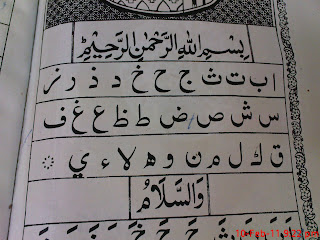
Islamization of Knowledge #2: The Rasm-Uthmani of the Quran and The History of writing


Reflection of the History of Writing
           There are many legends and stories about the invention of writing. Greek legend has it that Cadmus, Prince of Phoenicia and founder of city of Thebes, invented the alphabet and brought it with him to Greece. In one Chinese fable, the four-eyed dragon-god CangJie invented writing, but in another, writing first appeared as marking on the back of chi-lin, a white unicorn of Chinese legend. In other myths, the Babylonian god Nebo and the Egyptian god Thoth gave humans writing as well as speech. The Talmudic scholar Rabbi Akida believed that the alphabet existed before humans were created; and according to Islamic teaching, the alphabets were created by Allah himself, who presented it to humans but not to angels. Although these are delightful stories, it is evident that before a single word was written, uncountable billions were spoken. The invention of writing comes relatively late in human history, and its development was gradual. It is highly unlikely that a particularly gifted ancestor awoke one morning and decided, “Today I’ll invent a writing system.” - An Introduction to Language.

            In Islam, the holy Quran was written in Arabic language and Arabic alphabetical is used. The Quran was reveal gradually but it was to be memorized during the prophet of Muhammad as he forbids the verses to be written down by the companions. Later, the expansion of Islamic teachings has created confusion among the Muslims as different region speaks different language. The Rasm-Uthmani was introduced as guideline for the readings of the Quran and the Rasm-Uthmani in the Quran was set as the standard Arabic alphabet. It is called Rasm-Uthmani because the person that worked hard for the standard reading was Uthman bin Affan (r.a), the third caliph after Prophet Muhammad S.A.W and Abu Bakr (r.a).The book of An Introduction to Language has clearly state a false information about the facts of Arabic Alphabet by saying that Allah himself, who presented it to humans but not to angels. This information can be a mislead fact and it is a concern. The Arabic writing system before the Rasm-Uthmani is a very confusing without the markers that make the pronunciations only easier if the reader is a native speaker of Arabic language.

         Prepared by: Muhammad Norshafiq


References:
Fromkin, V. A., Rodman, R., & Hyams, N. (2007). Brain and Language. An Introduction to Language (8th Edition ed., pp. 35 - 61). Boston: Thomson Wadsworth.
Wednesday, 7 March 2012

Islamization of Knowledge #1: Islamic View of Language


Language, in general, is a shared code, tacitly known by “all” speakers of a language and linguistics is the study of human languages and natural language in general. Where language is seen as a mere means of communication among members of human communities, Islam considers language far beyond than that, where language is one of the uncountable blessings of Allah as well as a distinctive quality of humankind. It is with language that enables a normal human-being to proclaim his faith in Allah and the religion of Islam.

Ali Ibn Abi Talib narrated from the Prophet S.A.W:
Iman (faith) is established by a knowledge in heart, utterance in tongue, and action of organs.”

In comparison to other creatures, language acts as a complement to the mind as to establish the human’s superiority over other creations of Allah. The Qur’an too (Surah Ar-Rahman: 4 -1) has referred to language as a means of expression in the context of enumerating various types of mercy of Allah. It also relates the blessing of language expression together with revelation of the Qur’an and creation of humankind.


الرَّحْمَٰنُ ﴿١﴾ عَلَّمَ الْقُرْآنَ﴿۲﴾ خَلَقَ الْإِنسَانَ ﴿۳﴾ عَلَّمَهُ الْبَيَانَ﴿٤﴾
“The Most Gracious. It is He who has taught us the Qur’an. He has created man. He has taught him an intelligent expression.”(55: 1 – 4)

The position of linguistic expression has been allocated from the time of the human creation where Prophet Adam was taught the names of all things so that he may explore the world.
In Islam, as mentioned before, language is a gift from Allah and it is also under His control that enables human beings to have the ability to use language, or be granted the organs for this ability, especially on the Day of Judgment. The Qur’an says:

الْيَوْمَ نَخْتِمُ عَلَىٰ أَفْوَاهِهِمْ وَتُكَلِّمُنَا أَيْدِيهِمْ وَتَشْهَدُ أَرْجُلُهُم بِمَا كَانُوا يَكْسِبُونَ﴿٦٥﴾
“The Day shall we set a seal on their mouths. But their hands will speak to us, and their feet bear witness to all that they did.”(36:65)

Needless to say, Allah has the sole power and control to grant the capability to communicate through language be it the ability to speak in early childhood like the story of Isa a.s. (5:110), still creatures and other non-human speaking a human language (27:82), and such as the case of Sulaiman a.s. where was given the opportunity to understand communications among animals and converse with them (27:16).


                   Prepared by: Ida Nadirah


References:


Abdussalam, A. S. (1999). Islam and Language. Kuala Lumpur: Al-Hilal Publishing.
Fromkin, V. A., Rodman, R., & Hyams, N. (2007). What is Language?. An Introduction to Language (8th Edition ed., pp. 3-28). Boston: Thomson Wadsworth.
 
;